 Virtual Colossus
Technical specifications
The 1300 series was a range of second-generation computers, built with discrete germanium PNP transistors and diodes. They were designed as cost-efficient workhorses for commerce, for jobs such as payroll and accounting, rather than one- or two-off machines built for maximum performance at any cost for military or scientific work.
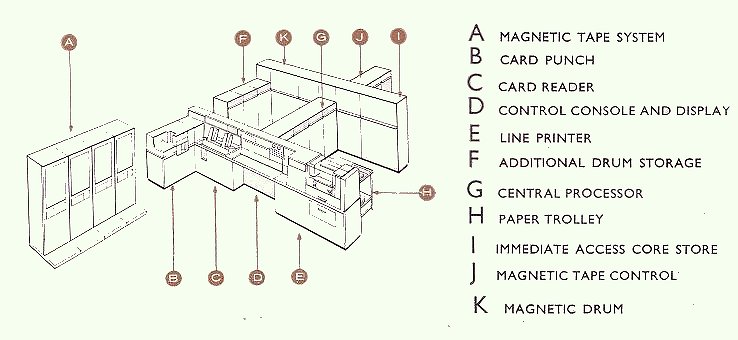
The “basic” 1301 has three peripherals: a card reader for 80-column punched cards, running at 600 cards a minute; a 120-column line printer, running at 600 lines a minute; and a card punch, running at 100 cards a minute. The CPU has close control of the peripherals; this unbuffered approach saves a lot of circuitry, and so cost. The peripherals’ performance was quite high for the period. The basic machine has core store and a drum backing store.
On top of this was the optional magnetic tape subsystem, which is buffered and contains almost as many logic circuits as the basic machine. It roughly doubled the cost of the machine when new, which in total was around a quarter of a million pounds. The subsystem is made up of the Data Transfer Unit (DTU) and interfaces for magnetic tape drives (up to eight could be supported).
Vital statistics
A few approximate vital statistics of the ICT 1301 computer with 1-inch magnetic tape:
- Size
- 20 ft wide by 22 ft long.
- Power
- A three-phase industrial supply.
- Transistors
- About 7,352 germanium transistors (and a single valve), which produced a lot of heat. If the temperature got too high, the resulting problems took a lot of hard work to find. The printed circuit boards weren’t pluggable, so when you thought you had found the faulty board, all you had to do was power off, remove up to 25 wire-wrap connections, replace the board, remake up to 25 wire-wrap connections, cross your fingers and power up again.
- Speed
- A 1 MHz clock. Processing was 4 bits wide, serial, 12 digits, with 3 main data registers plus 3 control registers. All the arithmetic was decimal, with an alternative set of functions for working in pounds, shillings and pence.
- Program store
- 2,000 12-digit words of fast “immediate access store”: ferrite core store, which with twelve-digit words equals 12 kilobytes.
- Drum store
- A further twelve thousand words of drum store; again, with 12-digit words, that is 72 kilobytes of drum, which could be used for overlaying program areas.
- Magnetic tape
- The machine shown has 4 one-inch magnetic tape units, each storing about 1.5 million twelve-digit words, around nine megabytes.
- Input and output
- 80-column punched cards, and printed output at 600 lines a minute.
Typical work for this type of machine was batch processing of large data files held on magnetic tape, although some other applications were tried. The programmers didn’t use an assembler: this was a machine driven directly by machine code, computing in the raw.
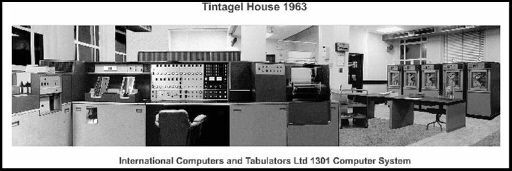
Information from the ICT 1301 Resurrection Project. More will follow on this page as time permits.
Unfamiliar terms, such as core store, drum store and the DTU, are explained in the glossary.